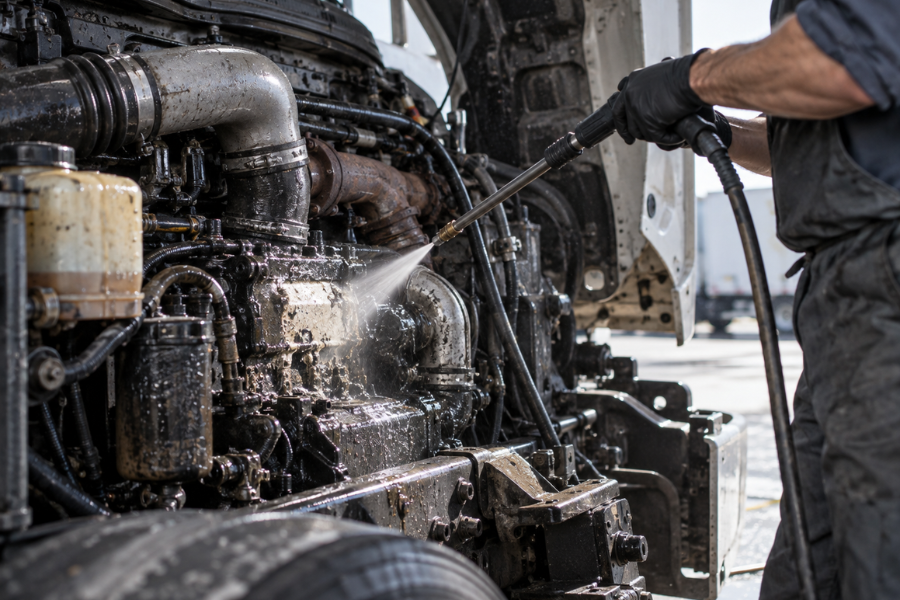
A hard-working truck engine rarely stays clean for long.
Oil mist, grease, road dust, mud, salt, fuel residue, and other contaminants gradually settle around the engine bay. As the buildup grows, it can trap heat, hide leaks, cover damaged parts, and make routine inspections more difficult.
That’s why a professional engine wash is more than an appearance service. It supports better visibility, easier maintenance, and responsible long-term equipment care.
At The Truck Wash, we help commercial drivers, owner-operators, fleet managers, and large-vehicle owners keep their equipment cleaner and easier to evaluate. Our team understands that your truck is more than transportation. It is a major investment and, for many drivers, the foundation of the business.
What Does a Professional Engine Wash Do?
A professional engine wash removes accumulated grime from accessible areas throughout the engine compartment.
The process targets contaminants that build up during normal commercial use, including grease, oil residue, dust, mud, road film, salt, and debris. Because engine bays contain sensitive components and different surface materials, the work requires a controlled approach.
Our team evaluates the condition of the engine bay before cleaning. We then use appropriate products and techniques to address the buildup without treating every engine exactly the same.
Drivers throughout Eastern Idaho can visit The Truck Wash for commercial vehicle cleaning services built around trucks, trailers, fleets, RVs, and other oversized equipment.
A professional engine wash can help:
Expose leaks and damaged components
Remove heat-trapping grime
Improve visibility during inspections
Create cleaner working conditions for maintenance
Remove corrosive road contaminants
Support a better-maintained appearance
Make future buildup easier to notice
An engine wash does not replace mechanical service. It creates a cleaner environment in which drivers and technicians can better identify concerns and perform necessary work.
A Clean Engine Bay Makes Leaks Easier to Find
Small leaks are easy to miss when every surface is already coated in grime.
Old oil, grease, and road film can spread across hoses, fittings, covers, and surrounding parts. When new fluid appears, it may blend into the existing buildup rather than standing out.
A professionally cleaned engine bay creates a clearer baseline.
After the old residue is removed, fresh leaks may become easier to identify. This can help drivers and maintenance teams recognize changes involving:
Engine oil
Coolant
Fuel
Power-steering fluid
Transmission fluid
Hydraulic fluid
Other vehicle systems
Finding a leak does not automatically reveal its source, and cleaning does not repair the problem. However, improved visibility can make the next inspection more productive.
That matters for owner-operators who rely on one truck and for fleet managers responsible for keeping multiple units on schedule.
Heavy Grime Can Hold Heat Around Components
Commercial engines generate substantial heat during normal operation.
Airflow and cooling systems are designed to manage that temperature, but thick layers of oil, dirt, and grease can hold heat against certain surfaces. Buildup may also collect around areas where airflow and visibility are already limited.
A professional engine wash removes the insulating layer of grime from accessible components.
This does not mean washing an engine will solve an overheating problem. Mechanical overheating can have many causes and requires proper diagnosis. Cleaning simply removes one condition that may contribute to heat retention or make heat-related problems harder to inspect.
Keeping the engine compartment cleaner also helps technicians see whether hoses, belts, wiring, connectors, and surrounding parts show signs of heat exposure or deterioration.
Engine Cleaning Supports More Effective Inspections
An inspection is only as useful as the visibility available.
When dirt covers fasteners, hoses, clamps, reservoirs, wiring, and metal surfaces, it becomes harder to assess their condition. A clean engine bay gives maintenance professionals a better view of the equipment they are examining.
Cleaning may help reveal:
Cracked or worn hoses
Loose connections
Damaged wiring covers
Corrosion
Fluid seepage
Deteriorated belts
Missing fasteners
Rub marks
Heat-damaged components
Areas requiring closer evaluation
This improved visibility can support preventive maintenance instead of forcing drivers to wait until a problem becomes obvious on the road.
At The Truck Wash, we provide professional cleaning. Any mechanical concern discovered afterward should be evaluated by a qualified technician.
Degreasing Targets the Toughest Buildup
Some engine bays need more than a standard rinse.
Grease, oil, and baked-on residue can cling tightly to metal surfaces and surrounding components. These contaminants may collect around the engine, undercarriage, suspension areas, wheel wells, and other working parts.
Professional degreasing targets that heavy buildup with products and methods chosen for commercial equipment.
Our information about degreasing explains how removing oily residue can improve cleanliness, visibility, and maintenance access.
Degreasing is particularly valuable when:
The engine bay has not been cleaned recently
Oil residue has spread across several surfaces
Road dust has bonded to greasy areas
A truck operates in muddy or industrial conditions
Equipment is being prepared for inspection or service
A fleet is establishing a more consistent maintenance standard
The right approach depends on the type, age, and condition of the vehicle. Our team evaluates those factors before beginning the work.
Road Salt and Winter Grime Can Accelerate Wear
Eastern Idaho winters are hard on commercial vehicles.
Road salt, deicing compounds, slush, mud, and moisture can reach the engine compartment and undercarriage. Once deposited, those contaminants may remain in seams, around brackets, and on exposed metal surfaces.
Salt-related residue is particularly concerning because it can support corrosion when it stays in contact with metal.
Regular professional cleaning helps remove seasonal buildup before it remains on the equipment indefinitely.
Winter grime may collect around:
Engine-bay surfaces
Frame components
Brackets and fasteners
Battery areas
Wheel wells
Suspension parts
Lower panels
Undercarriage components
A complete commercial vehicle cleaning plan may combine an engine wash, exterior washing, undercarriage attention, and professional degreasing.
Our guide to truck and trailer washing explains why consistent cleaning matters for equipment exposed to demanding road conditions.
Cleaner Equipment Creates Better Working Conditions
Engine maintenance is already detailed work. Thick grime makes it more unpleasant and more difficult.
Technicians may need to reach around hoses, inspect tight spaces, remove covers, or work beneath the vehicle. Heavy deposits of oil and dirt can coat tools, gloves, clothing, and nearby components.
A professionally cleaned engine bay creates a more manageable work area.
Cleaner equipment can help technicians:
Handle parts more securely
See labels and markings
Identify new fluid residue
Access fasteners more easily
Reduce unnecessary contact with old grime
Complete visual inspections more efficiently
This does not guarantee faster repairs, but it removes an avoidable obstacle from the maintenance process.
For fleet operators, cleaner vehicles can also support more consistent shop standards across multiple units.
Professional Service Protects Sensitive Components
Modern engine compartments contain far more than heavy metal parts.
Sensors, wiring, electronic modules, connectors, intake components, seals, and other sensitive systems may all be present. That is why engine washing should be handled with care.
Professional service considers:
The location of electrical components
Existing damage or loose connections
The age and condition of the vehicle
The type of buildup present
Different surface materials
Appropriate water pressure
Product application
Drying and inspection needs
Our goal is not to blast every surface indiscriminately. We use a controlled process based on the equipment in front of us.
The same attention to detail shapes our approach to hand washing for commercial trucks, RVs, and other large vehicles.
Hands-on care allows our team to focus on the areas that need attention while respecting the vehicle’s construction and finishes.
Engine Washing Helps Establish a Maintenance Baseline
A maintenance baseline gives drivers and fleet managers a clearer picture of what is normal for a vehicle.
When an engine bay is covered in years of residue, it is difficult to know whether a stain is old or recent. After professional cleaning, changes become more noticeable.
For example, fresh oil around a fitting or new coolant residue near a hose may stand out against a previously cleaned surface.
This makes engine washing useful when:
Adding a used truck to a fleet
Preparing equipment for a major inspection
Starting a new preventive maintenance schedule
Returning a stored vehicle to service
Evaluating a truck before sale
Investigating recurring fluid residue
Preparing for professional mechanical work
A clean baseline helps owners understand what develops after service rather than guessing how long the buildup has been present.
Fleet-Wide Cleaning Supports Consistent Equipment Care
Fleet maintenance becomes more complicated as the number of vehicles increases.
Each truck may travel different routes, carry different loads, and operate under different weather conditions. Without a consistent cleaning process, some engine bays may remain relatively clean while others accumulate severe buildup.
Professional engine washing gives fleet managers a repeatable service that can be incorporated into broader maintenance planning.
Cleaning schedules may be based on:
Mileage
Seasonal exposure
Route conditions
Visible oil or grease
Inspection intervals
Vehicle age
Maintenance appointments
Fleet resale plans
Heavy-duty use
A consistent standard makes it easier to compare equipment and identify changes between service intervals.
It also shows drivers and maintenance teams that cleanliness is part of equipment care, not an afterthought.
Engine Cleaning Supports a Professional Presentation
Customers may not inspect the engine bay during every delivery, but equipment condition still shapes a company’s image.
A clean truck suggests that the operator pays attention to maintenance and presentation. This can matter during inspections, sales, trade-ins, fleet evaluations, and customer-facing events.
Owner-operators often take particular pride in the condition of their equipment. A professionally cleaned engine bay complements a polished exterior and well-kept cab.
Our truck detailing services help drivers improve the overall presentation of trucks, RVs, buses, boats, and other large vehicles.
Detailing may address:
Cab interiors
Seats and surfaces
Windows
Exterior finishes
Tires and trim
Engine-bay appearance
Hard-to-reach areas
A clean engine bay completes the picture. The truck does not merely look maintained from a distance. The care extends beneath the hood.
Engine Washes Can Help With Resale Preparation
A buyer evaluating a used commercial truck wants to see the condition of the equipment clearly.
Heavy grime can create uncertainty. It may conceal leaks, corrosion, damaged hoses, or other visible problems. Even when the vehicle is mechanically sound, a neglected engine bay can make buyers wonder what else has been overlooked.
Professional engine cleaning helps present the equipment more honestly and clearly.
It may support resale preparation by:
Improving visual appeal
Making inspection easier
Removing old fluid residue
Helping visible components stand out
Creating cleaner listing photos
Showing attention to equipment care
An engine wash cannot increase the mechanical condition of a vehicle by itself. It can make the existing condition easier to evaluate and improve the overall presentation.
For fleet managers rotating equipment, that difference may help a truck make a stronger first impression.
Large Vehicles Need a Facility Built for the Job
Commercial trucks, motor coaches, RVs, and buses require space and equipment that ordinary vehicle washes may not provide.
Our facility is designed to accommodate oversized vehicles and the heavy buildup they encounter. We understand the practical needs of professional drivers and large-vehicle owners.
Beyond engine washing, our services include:
Truck and trailer washing
Degreasing
Aluminum trailer and accessory brightening
Truck detailing
Trailer washouts
Certified truck weighing
RV and motor coach cleaning
Our RV/motor coach and tour bus washing services extend professional large-vehicle care to recreational and passenger equipment.
Customers can also relax in our drivers lounge while appropriate services are completed. The comfortable waiting area and free Wi-Fi give drivers a useful place to take a break before returning to the road.
Give Your Engine Bay the Professional Attention It Needs
A dirty engine bay does not always cause an immediate problem. That is exactly why buildup can be easy to ignore.
Over time, grease and road grime can hide leaks, trap heat, cover damaged parts, and make routine inspections more difficult. Professional engine washing removes that barrier and gives drivers, fleet managers, and technicians a clearer view of the equipment.
At The Truck Wash, we provide careful engine washes, degreasing, exterior washing, detailing, and related large-vehicle services for Idaho Falls and Southeast Idaho.
Contact our team to schedule an engine wash and give your truck a cleaner foundation for inspections, maintenance, performance, and long-term service.
Related Questions
Should an engine be cool before professional washing?
Yes. Engine temperature affects how cleaning products and water interact with surfaces. Our team follows an appropriate process based on the vehicle’s condition.
Can an engine wash remove burnt-on oil stains?
Professional washing and degreasing can reduce heavy residue, but deeply baked-on stains may not disappear completely after one service.
Is engine washing suitable for older commercial trucks?
Many older trucks can be professionally cleaned, but worn wiring, damaged seals, and other existing conditions must be considered before service.
Can a clean engine bay help during a pre-purchase inspection?
Yes. Removing old grime can make leaks, corrosion, worn hoses, and other visible concerns easier for a qualified inspector to identify.